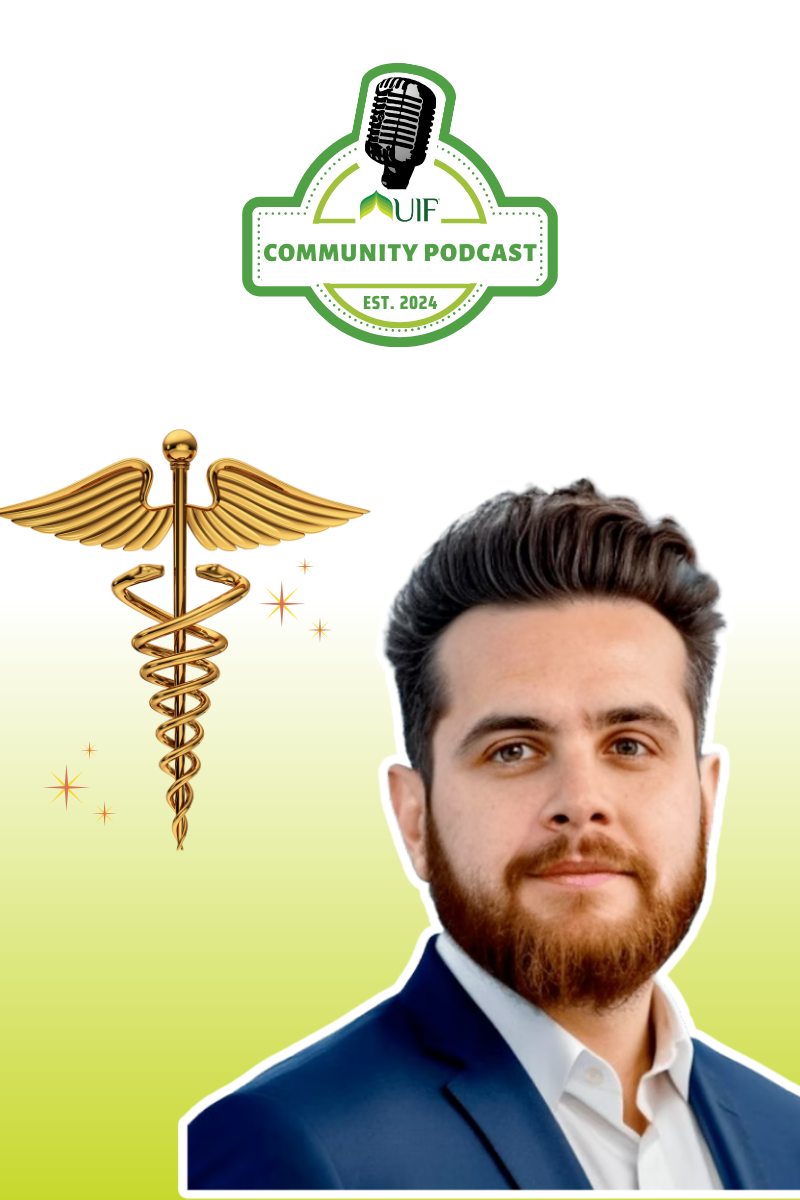
Many people dream about starting a business. Far fewer are willing to leave the comfort of a successful career to pursue that dream.
For Dr. Saamer Siddiqi, entrepreneurship wasn’t part of the original plan. As a practicing physician in the Chicagoland area, he had already achieved what many would consider a successful career. Yet through years of treating patients and working within the healthcare system, he began noticing opportunities to improve how care was delivered.
Rather than simply accepting the status quo, he decided to do something about it.
On this episode of the UIF Community Podcast, Dr. Siddiqi shared his journey from physician to founder of LIVEMED Telehealth, a fast-growing healthcare technology company focused on expanding access to care through virtual medicine. Along the way, he offered valuable lessons about leadership, innovation, risk-taking, and building a business that solves real-world problems.
The Best Entrepreneurs Start by Solving Problems
Many successful companies begin with a simple observation:
“There has to be a better way.”
As a physician, Dr. Siddiqi spent years caring for patients and experiencing firsthand many of the inefficiencies that exist within healthcare. Long wait times, limited access to specialists, geographic barriers, and scheduling challenges often create obstacles for patients seeking care.
Instead of viewing these frustrations as unavoidable, he saw them as opportunities.
This mindset represents one of the most important traits of entrepreneurship. Great business ideas rarely begin with a desire to build a company. More often, they begin with a desire to solve a meaningful problem.
The most successful entrepreneurs spend less time asking, “What business should I start?” and more time asking, “What problem needs solving?”
Expertise Creates Opportunity
Many people assume entrepreneurs need to become experts in everything.
In reality, successful founders often begin with expertise in one specific area and build from there.
For Dr. Siddiqi, years of medical training and clinical experience provided something incredibly valuable: a deep understanding of the healthcare system and the needs of patients. That knowledge became the foundation upon which LIVEMED was built.
This lesson applies far beyond medicine.
Teachers understand educational challenges. Engineers understand technical challenges. Financial professionals understand financial challenges.
Often, the best business opportunities exist within the industries we already know well. The key is recognizing that expertise itself can become a competitive advantage.
Growth Requires Leaving Your Comfort Zone
One of the most fascinating aspects of entrepreneurship is how frequently founders must learn entirely new skills.
A physician may suddenly need to understand hiring, operations, marketing, software development, fundraising, or strategic planning. An engineer may need to learn sales. A teacher may need to learn accounting.
Building a company often requires becoming comfortable with being uncomfortable.
The transition from practitioner to entrepreneur requires a significant mindset shift. Instead of focusing solely on your own performance, you begin thinking about systems, teams, processes, and long-term growth.
That evolution can be challenging, but it is often where the greatest personal and professional growth occurs.
Innovation Happens at the Intersection of Industries
Some of the most impactful innovations occur when expertise from one field is combined with tools from another.
Healthcare and technology provide a perfect example.
For decades, healthcare relied heavily on in-person interactions. While many aspects of medicine will always require face-to-face care, technological advances have created opportunities to improve accessibility, efficiency, and convenience for millions of patients.
Telehealth is one example of how innovation can bridge those gaps.
By combining medical expertise with technology, companies like LIVEMED are helping patients access care in ways that would have been difficult or impossible just a generation ago.
The lesson extends beyond healthcare. Innovation often occurs when people look outside their own industry and ask how successful ideas from one field might improve another.
Building a Team Is Different Than Building a Career
Many professionals spend years learning how to excel individually.
Entrepreneurship introduces a new challenge: helping others succeed.
As companies grow, founders quickly learn that long-term success depends less on individual effort and more on the strength of the team around them.
Hiring the right people, building a strong culture, and empowering others to contribute become critical responsibilities.
A great founder eventually stops asking, “How can I do this myself?” and begins asking, “How can we build a team capable of accomplishing this together?”
The ability to attract talented people around a shared mission often determines whether a business remains small or grows into something far more impactful.
Why Purpose Matters
Many businesses are built to generate revenue.
The most enduring businesses are often built around a mission.
Throughout the conversation, a recurring theme emerged: improving people’s lives.
Whether through better access to healthcare, more efficient delivery systems, or innovative technology, purpose remained at the center of the discussion.
That sense of mission is often what sustains entrepreneurs through uncertainty, setbacks, and difficult decisions. Financial success may provide motivation, but purpose provides endurance.
When people genuinely believe in the problem they are solving, they become more resilient when challenges inevitably arise.
The Future Belongs to Problem Solvers
The world is changing faster than ever.
Technology continues to reshape industries, create new opportunities, and challenge traditional ways of thinking. Yet one thing remains constant: organizations that solve meaningful problems will always create value.
Dr. Saamer Siddiqi’s journey from physician to entrepreneur serves as a powerful reminder that innovation doesn’t require abandoning your expertise. In many cases, it begins by applying that expertise in new ways.
Whether you’re a physician, educator, engineer, business professional, or student, opportunities often exist much closer than you think. The challenge is being willing to recognize them . . . and having the courage to pursue them.
Sometimes the most impactful careers aren’t built by choosing between professional success and entrepreneurship.
They’re built by finding a way to combine both.
Share This Story, Choose Your Platform!