For many people, politics feels distant. It’s something that happens in state capitols, city halls, and Washington D.C., far removed from everyday life. Yet the reality is that political decisions affect nearly every aspect of our communities, from education and housing to public safety, civil rights, and economic opportunity.
The question isn’t whether politics impacts our lives. The question is whether we’re willing to engage with it.
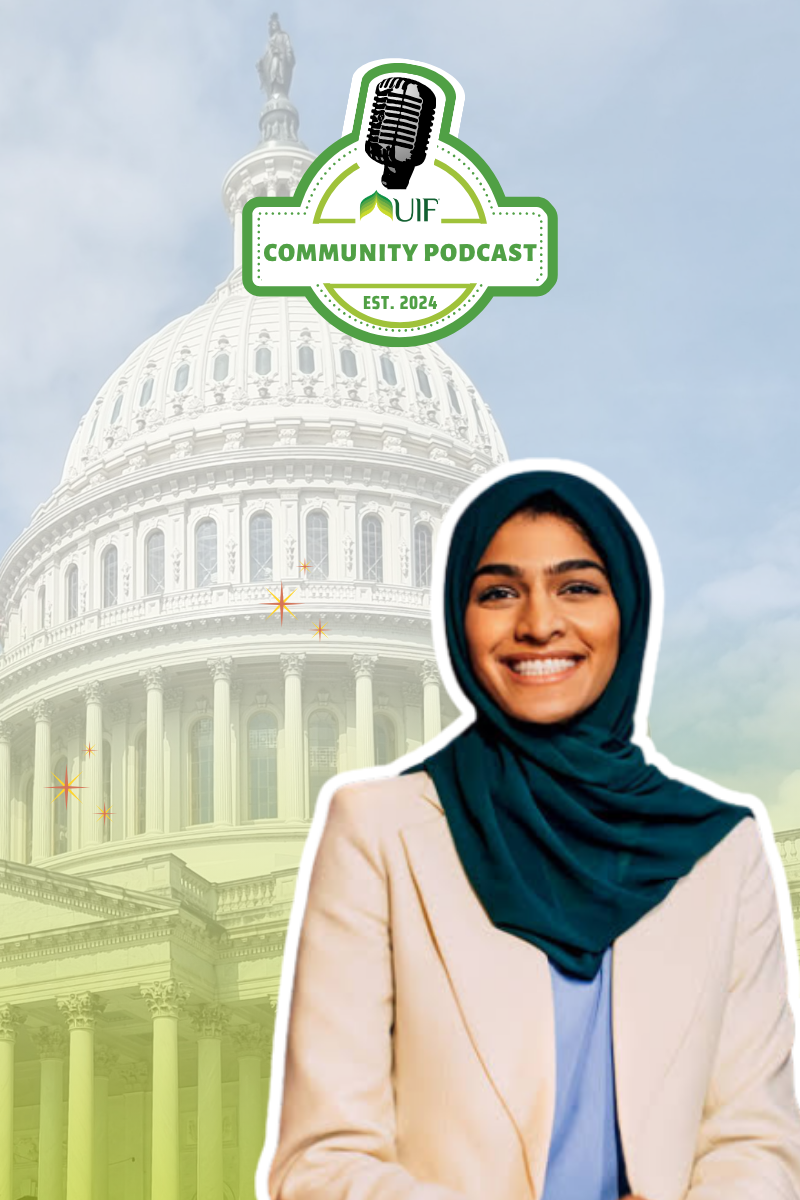
On a recent episode of the UIF Community Podcast, we sat down with Illinois State Representative Nabeela Syed and civil rights attorney Faiyaz Hussain to discuss public service, civic engagement, and what it means to advocate for your community while remaining grounded in your values. Representative Syed made history as one of the youngest Muslim women elected to public office after flipping a longtime Republican district at just 23 years old, while Faiyaz Hussain has spent years advancing civil rights and public policy initiatives affecting Muslim communities across the country.
Their stories offer important lessons not only for aspiring public servants, but for anyone interested in creating positive change.
Leadership Often Begins Before You Have a Title
When people think about leadership, they often picture elected officials, CEOs, or prominent community figures. In reality, leadership usually begins long before a title is ever earned.
Many public servants start as volunteers, organizers, advocates, or simply concerned community members who recognize a problem and decide to get involved. They attend local meetings, support causes they believe in, and gradually develop a deeper understanding of how change happens.
Representative Syed’s journey illustrates an important principle: leadership is not something reserved for a select few. It is often the result of ordinary people taking consistent action over time.
For young Muslims especially, her story challenges the notion that age, background, or lack of political connections should prevent someone from making an impact.
Representation Matters
One of the recurring themes in discussions about civic engagement is representation.
Communities benefit when decision-makers understand the experiences, concerns, and aspirations of the people they serve. Diverse perspectives often lead to more thoughtful conversations and more effective solutions.
As one of the youngest Muslim women elected to public office in Illinois, Nabeela Syed’s success reflects broader changes taking place across the country. More Muslims are becoming involved in public service, community leadership, and advocacy efforts than ever before.
Representation alone, however, is not the goal.
The ultimate objective is meaningful participation. Communities thrive when individuals move beyond simply observing public affairs and begin contributing to them.
Whether through voting, volunteering, advocacy, or public service, engagement creates opportunities to shape the future rather than simply react to it.
Faith and Public Service Can Coexist
Some people view faith and politics as entirely separate worlds.
Others believe that religious values should inform how individuals approach public service, ethical decision-making, and community engagement.
For many Muslim professionals, entrepreneurs, educators, and public servants, faith serves as a framework for values such as justice, compassion, honesty, accountability, and service to others.
These principles are not confined to personal worship. They can influence how people lead organizations, build businesses, serve clients, and participate in civic life.
The conversation highlights an important reality: engaging in public service does not require abandoning one’s identity. In many cases, a strong sense of identity can provide clarity and purpose when navigating difficult decisions.
Change Requires Building Relationships
Political discussions often focus on disagreement.
Yet meaningful progress frequently depends on the ability to work with people who hold different views.
One of the most valuable skills in leadership is learning how to build relationships across ideological, cultural, and political differences. While disagreements are inevitable, lasting solutions often emerge through dialogue, collaboration, and mutual respect.
This lesson extends far beyond politics.
Whether you’re managing a team, running a business, serving customers, or participating in community organizations, success often depends on your ability to communicate effectively with people who see the world differently than you do.
The strongest leaders are not necessarily those who speak the loudest. They are often those who listen carefully, build trust, and find common ground.
Advocacy Doesn’t Require Running for Office
One misconception about civic engagement is that meaningful impact requires holding elected office; some of the most influential people in any community never run at all.
Attorneys advocate for civil rights. Educators shape future generations. Business leaders create economic opportunities. Volunteers support local initiatives. Community organizations address challenges that government alone cannot solve.
Faiyaz Hussain’s work in civil rights and policy advocacy demonstrates that there are many paths to creating meaningful change. Legal advocacy, public education, coalition building, and grassroots organizing can all play important roles in strengthening communities.
Every individual has the ability to contribute; the question is not whether you can make a difference – it’s how you choose to do so.
The Importance of Civic Engagement
Many people underestimate the influence they possess as citizens. Local elections, school boards, city councils, and state legislatures often make decisions that have a direct impact on daily life. Yet these levels of government frequently receive far less attention than national politics.
Communities are strongest when people remain informed, participate in the democratic process, and take an active interest in the issues affecting their neighbors.
Civic engagement doesn’t require becoming a policy expert, sometimes it starts with attending a meeting, asking questions, supporting a cause, or simply taking the time to understand how decisions are made. Small actions, when repeated consistently across a community, can create significant change over time.
Creating a Legacy of Service
Perhaps the most inspiring takeaway from this conversation is that leadership is ultimately about service.
Titles, elections, and public recognition may come and go. What lasts is the impact people have on the communities they serve.
The journeys of Nabeela Syed and Faiyaz Hussain remind us that meaningful change rarely happens by accident. It happens because individuals are willing to step forward, accept responsibility, and contribute their talents toward a cause greater than themselves.
Whether your path leads to public office, community organizing, business leadership, education, or advocacy, the underlying principle remains the same: lasting impact begins when people choose engagement over apathy and service over self-interest.
At a time when many feel disconnected from the political process, their stories offer a powerful reminder that positive change is still possible; and that the next generation of leaders may already be sitting in our classrooms, working in our communities, or serving quietly behind the scenes today.
Share This Story, Choose Your Platform!